
Present. Partner. Progress.
Show up with purpose, build value-based partnerships, and grow wealth together!
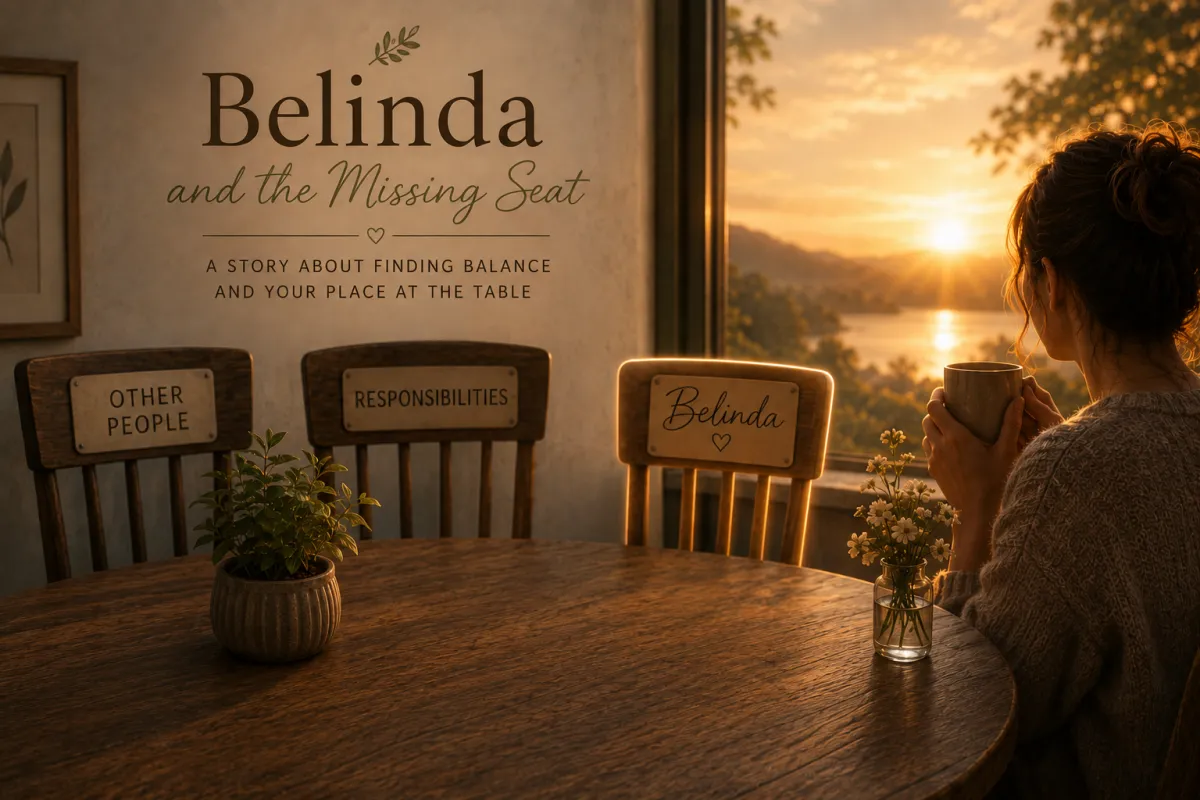
Belinda and the Missing Seat
Belinda and the Missing Seat
A Story About Finding Balance and Your Place at the Table
🌿 Belinda and the Missing Seat
A Story About Finding Balance and Your Place at the Table
🌱 Part One: The Disappearing
Belinda had always been good at caring for people.
As a little girl, she learned early that being “good” meant being helpful.
Her parents loved her deeply. They wanted the best for her. They encouraged achievement, hard work, and excellence. They celebrated success and pushed her to reach her potential.
But somewhere along the way, Belinda learned a lesson that nobody intended to teach her.
She learned that other people’s voices mattered more than her own.
When adults spoke, she listened.
When teachers instructed, she obeyed.
When expectations were placed upon her, she carried them.
When others needed something, she provided it.
Gradually, she became so skilled at paying attention to everyone else that she barely paid attention to herself.
Without realising it, Belinda learned to prioritise everyone else’s needs while overlooking her own.
She became:
✨ Responsible
✨ Dependable
✨ Helpful
✨ Supportive
✨ Accommodating
And everyone loved her for it.
What nobody realised was that Belinda was slowly disappearing.
Including Belinda herself.
As the years passed, this pattern followed her into adulthood.
At work, she became the employee who always said yes.
Among friends, she became the listener.
In her marriage, she became the one who adjusted.
As a mother, she became the one who sacrificed.
And when she became a therapist, she became the one who carried everyone else’s pain.
Clients came to her because she cared deeply.
Colleagues relied on her because she was dependable.
Friends called because she always answered.
Family members depended on her because she rarely asked for anything in return.
Belinda became an expert at supporting others.
But she had struggled to learn how to truly support herself.
She believed this was what love looked like.
She believed this was what kindness looked like.
She believed this was what being a good woman looked like.
Yet year after year, something inside her became increasingly tired.
At first, it looked like exhaustion.
Then irritability.
Then resentment.
Then tears she could not explain.
Then compassion fatigue.
Then burnout.
🌿 Part Two: The Missing Seat
One evening after work, Belinda sat alone in her car.
The parking lot was almost empty.
Her hands rested heavily on the steering wheel.
She was exhausted.
Not physically.
Soul exhausted.
For the first time in years, she asked herself a simple question:
"What do I need?"
The silence that followed frightened her.
Because she genuinely did not know.
She had spent so much of her life listening to everyone else’s needs that she had almost forgotten how to hear her own voice.
Soon after, Belinda sought support.
As she began talking through her life, a pattern emerged.
Every story involved someone else’s needs.
Every decision involved someone else’s feelings.
Every sacrifice involved Belinda giving up something important.
One day her therapist drew three chairs.
The first chair was labelled: OTHER PEOPLE
The second chair: RESPONSIBILITIES
The third chair: BELINDA
Then she asked: “Which chair receives the most attention?”
Belinda pointed to Other People.
“And the second most?”
Responsibilities.
The therapist smiled gently.
“And which chair receives whatever is left?”
Belinda stared at her own name.
She finally acknowledged something she had never wanted to admit.
Everyone had a seat at the table.
Except her.
The realisation was painful.
But it was also the beginning of healing.
Over time Belinda began identifying her own values.
Peace. Truth. Rest. Health. Joy. Creativity. Mutual respect. Partnership.
She began asking questions she had never learned to ask:
What do I think?
What do I feel?
What do I need?
What matters to me?
At first, the answers were small.
But slowly, they grew stronger.
🌿 Part Three: The Pendulum Swings
Then something unexpected happened.
As Belinda began healing, the pendulum swung.
For years she had lived at one extreme.
Silence. Self-sacrifice. People-pleasing. Avoidance. Fear of disappointing others.
Now she began moving toward the opposite extreme.
If she felt frustrated, she spoke immediately.
If she felt hurt, she reacted quickly.
If she disagreed, she said so.
If she wanted something, she pushed for it.
After years of suppressing herself, she felt a growing compulsion to express almost everything.
She shared too much.
Spoke too quickly.
Explained too much.
Sometimes she was harsher than she intended.
Sometimes she confused honesty with urgency.
Sometimes she left conversations feeling exposed, embarrassed, and uncertain.
One evening after a difficult conversation with her husband, she sat crying in her car.
“I thought learning to speak up would make me feel better,” she told her mentor.
Her mentor smiled.
“Learning to speak up is healthy.”
Then she paused.
“Learning when, how, and why to speak up is wisdom.”
She drew a pendulum.
At one end she wrote: People-Pleasing
At the other: Reactivity
Then she pointed to the centre.
“Balance.”
Belinda finally understood.
She was not failing.
She was swinging.
🌿 Part Four: Learning to Pause
On another evening, after a sharp exchange with her husband over something small — a missed appointment, a forgotten message — Belinda stopped.
Not because she had nothing to say.
But because she was learning to ask herself three questions before she spoke.
What am I feeling right now?
She sat with that. Hurt, she realised. Not anger. Hurt underneath the anger.
What am I thinking?
That he doesn’t notice how hard I try. That I am invisible again.
What do I need?
To be seen. To feel like I matter to him.
Those three questions took less than two minutes. But they changed everything about what came next.
🌿Part Five: Safe Conversations
Later that evening, when they were both calmer, Belinda asked her husband if they could talk. Not argue. Talk.
She had been learning something called Safe Conversation — a way of speaking and listening that removed criticism, judgment, and defensiveness from the equation. A structure that made honesty feel less like an attack and more like an invitation.
She began with what she had learned to call a soft opening.
“I’d like to share something with you,” she said quietly. “And I just need you to listen for now. You’ll have your turn.”
He nodded.
“When the appointment was missed today, I felt invisible. I know that probably wasn’t your intention. But that’s what came up for me. And what I need is to feel like I’m a priority sometimes. Not always. Just sometimes.”
She watched his face.
He didn’t defend himself.
He didn’t correct her timeline.
He didn’t minimise what she felt.
Because they had both been practising this.
“What I’m hearing you say,” he said slowly, “is that when things like this happen, you feel like you don’t matter to me. Is that right?”
“Yes,” she said. “That’s exactly it.”
Something in the room shifted.
No winner. No loser.
Just two people learning to be honest without being brutal.
When it was his turn, Belinda listened the same way. Without interrupting. Without building her defence. Without waiting for her chance to speak.
She listened to understand.
It wasn’t perfect. There were moments of awkwardness. Moments where old habits nudged at the door.
But nobody withdrew.
Nobody went silent.
Nobody walked away.
And that, Belinda realised, was the miracle.
Not the absence of conflict.
But the presence of safety inside it.
She kept practising. The questions. The pauses. The safe conversations. Not because it was easy, but because she was finally learning that her voice didn’t have to be a weapon or a whisper. It could simply be the truth, offered with care.
🌿Part Six: Feelings Are Messengers, Not Masters
When emotions rose, she learned to notice them.
When fear appeared, she learned to sit with it.
When rejection surfaced, she learned to explore it rather than obey it.
She learned how to identify emotions without becoming controlled by them.
She learned that feelings were messengers, not masters.
They carried information.
They did not have to dictate her behaviour.
She was learning that she didn’t have to obey every emotion she felt.
She could listen to it.
Learn from it.
And then choose her response.
Finally, Belinda felt she was becoming the author of her choices rather than the prisoner of her emotions.
🌿Part Seven: A Deeper Source
At the same time, her relationship with God deepened.
What had once been occasional prayer became daily conversation.
What had once been seeking God only during crises became a steady partnership.
She began bringing her fears, decisions, disappointments, hopes, and relationships before God.
Slowly she discovered something beautiful.
God was becoming her source and her security.
Not approval.
Not achievement.
Not being needed.
Not being indispensable.
God.
She learned to ask:
“Lord, what are You saying?”
“What do You want me to do?”
“What am I saying yes to?”
“What am I saying no to?”
As years passed, she noticed something changing within her.
She became calmer.
More grounded.
More patient.
More self-controlled.
The fruit of the Spirit grew slowly.
Not in days.
Not in weeks.
But over years.
Patience. Gentleness. Peace. Self-control. Faithfulness.
The Holy Spirit became the still voice at the centre of her relationships.
Instead of reacting from fear, she learned to respond from wisdom.
Instead of chasing approval, she learned to seek God’s direction.
Instead of abandoning herself for others, she learned to honour both herself and others.
🌿Part Eight: When the Home Begins to Change
This transformation did not go unnoticed.
At first, some people resisted.
Friends became uncomfortable.
Family members were confused.
Her husband had to learn a new way of relating to her.
Her children struggled with the changes.
For years they had grown accustomed to a mother who immediately responded to every request, every demand, every interruption.
Now they encountered something different.
A mother with boundaries.
A mother who rested.
A mother who sometimes said no.
A mother who had needs too.
Initially, there was tension.
But Belinda began to understand something important.
She had not created the dynamic alone.
Others had participated in it.
Yet she had helped maintain it.
And now she had the responsibility of changing her part.
Over time, her family adjusted.
The home culture began changing.
Conversations became safer.
Instead of criticism, there was curiosity.
Instead of blame, there was responsibility.
Instead of emotional explosions, there were pauses.
The family learned to take time-outs when emotions became overwhelming.
They learned to repair after conflict.
They learned to talk through challenges.
They learned that emotions were safe.
Not something to fear.
Not something to avoid.
Not something to dump onto others.
Simply something to understand.
Belinda taught her children many of the tools she had spent years learning herself.
How to identify emotions.
How to regulate themselves.
How to express needs respectfully.
How to recover after mistakes.
How to remain connected during disagreement.
As her children entered their teenage years, she began seeing something she had longed for her entire life.
Security.
Not perfection.
Security.
A home where people could be honest.
A home where people could grow.
A home where challenges became opportunities for learning.
A home where mistakes did not threaten belonging.
🌿Part Nine: Balance in Her Work
After years of self-doubt, Belinda had finally found the courage to start her own business.
And the changes she was making in herself began reaching into that business too.
For years Belinda believed serving people meant giving more.
More time. More energy. More availability. More of herself.
She undercharged.
Overdelivered.
Overextended.
Then wondered why she felt depleted.
Eventually she learned another lesson about balance.
Healthy service serves both people.
The client receives value.
The provider remains healthy.
Neither person is exploited.
She became more intentional about who she worked with.
She became more selective about who she poured herself into.
She began choosing clients who valued growth.
Clients who respected boundaries.
Clients who were willing to participate in the work.
Clients who understood partnership.
Ironically, her business became healthier and began to make real progress.
🌿Part Ten: A Seat at the Table
There were still moments when old fears resurfaced.
Moments when she wanted to please.
Moments when she worried about disappointing people.
Moments when she slipped back into old habits.
But now she recovered more quickly.
She was learning to release the grip of perfection.
She simply returned to centre.
Again.
And again.
And again.
One rainy afternoon, many years after beginning her healing journey, Belinda sat quietly by a café window.
As she watched the rain fall, she reflected on the woman she used to be.
The woman who believed her value came from what she could do for others.
The woman who believed love required exhaustion.
The woman who thought self-sacrifice and self-neglect were the same thing.
The woman who never gave herself a seat at the table.
And she smiled.
Because now she understood something she wished she had known years earlier.
Balance is not choosing yourself instead of others.
Balance is choosing yourself with others.
It is hearing your voice alongside theirs.
Honouring your needs alongside theirs.
Valuing your wellbeing alongside theirs.
Because healthy relationships are not built when one person matters more than everyone else.
Nor are they built when everyone else matters more than one person.
They are built when everyone — including you — has a seat at the table.
And nobody is left standing outside the room.
Especially you.
What About You?
As you read Belinda's story, which part resonated most?
• Are you carrying responsibilities that were never meant to be yours?
• Have you become so focused on others that you've lost sight of yourself?
• Are you currently in the pendulum swing between people-pleasing and healthy boundaries?
• What would it look like to give yourself a seat at the table?
❤️ Remember
Balance is not selfish.
Boundaries are not rejection.
Your needs matter.
Your voice matters.
Your wellbeing matters.
Because you were never meant to spend your life caring for everyone except yourself.
🌱 Invitation
If Belinda's story resonates with you, take a few moments today to ask yourself the question that began her healing journey:
"What do I need?"
Then pause long enough to listen.
Your answer may be the beginning of your own journey back to balance. 🌿
Ready to Begin?
Book a call to start your journey today:


Empowering you to grow, succeed, and thrive. Our mission is to provide expert guidance, transformative resources, and unwavering support on your journey to a better life. Stay connected for inspiration, coaching insights, and life-changing opportunities.
Quick Links
Contact Us
Legal
© BreezeHighFlyers. 2026 All Rights Reserved.