
Present. Partner. Progress.
Show up with purpose, build value-based partnerships, and grow wealth together!
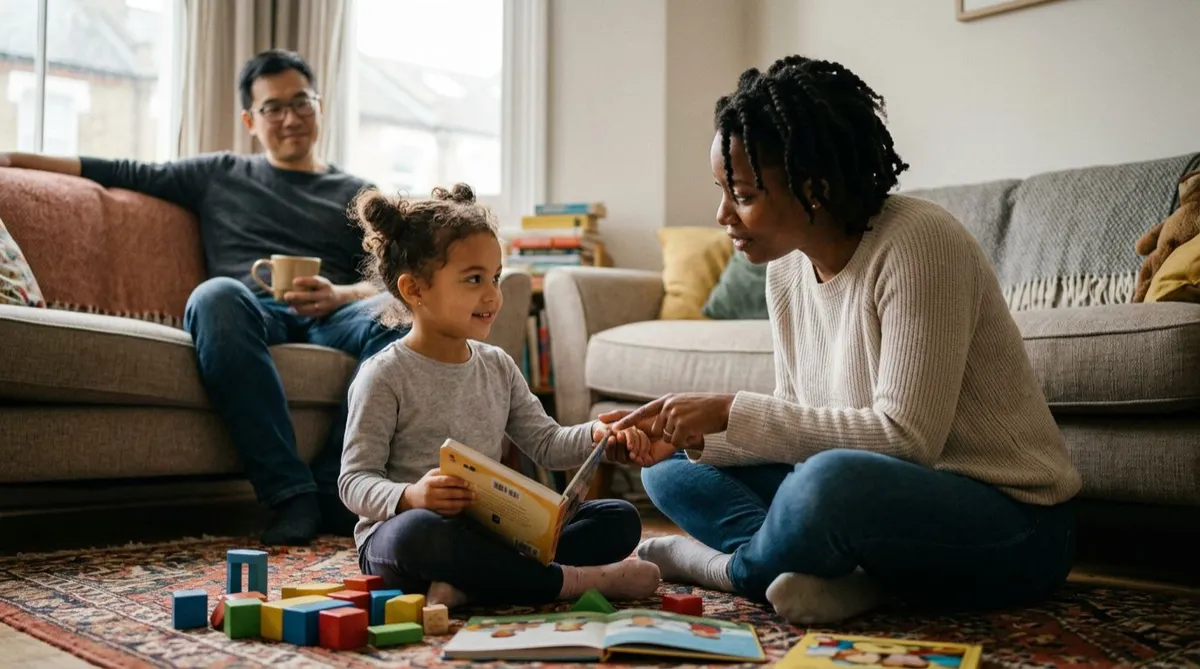
Learning to Lead with Connection
Learning to Lead with Connection
Why Healthy Relationships—Not Perfect Parenting—Shape Your Child's Future
"Children are not projects to complete. They are people to know, love, and journey with."
Your child slams the door. Again. And somewhere underneath your frustration is a quiet question: Am I raising a good kid, or just managing behaviour until they leave home?
One of the greatest misconceptions about parenting is that our primary role is to raise successful children.
Success matters. Character matters. Responsibility matters.
But none of these flourish in the absence of one essential ingredient:
Connection.
Long before your child remembers your rules, they will remember how safe they felt with you.
Long before they remember your discipline, they will remember whether they felt accepted.
Long before they seek your advice as adults, they will decide whether you are someone they can trust.
That is why effective parenting is less about controlling behaviour and more about cultivating relationship.
At the heart of the Partnering in Parenthood approach is a simple but transformational shift:
Don't just parent your child. Partner with them.
Partnership does not remove parental authority.
It transforms how authority is exercised.
Instead of asking,
"How do I get my child to do what I want?"
we begin asking,
"How do I build a relationship strong enough that we can navigate life together?"
That relationship begins today—not when they become adults.
Children Are Not Trophies
When was the last time you were more relieved by your child's good behaviour than curious about what was underneath it?
Without realising it, many parents begin seeing children through the lens of achievement.
Are they behaving? Are they succeeding? Are they making me look like a good parent? Are they becoming who I imagined?
When this happens, children slowly become projects instead of people.
Our attention shifts from who they are to what they do.
Yet genuine love always values the person above their performance.
Real love says:
"You matter before your achievements."
"You are valuable before you accomplish anything."
"You belong before you perform."
This mirrors the way God relates to us. Long before we ever served Him, accomplished anything, or grew spiritually mature, He loved us—not because of our usefulness, but because we were His.
Children need exactly the same experience.
What Love Really Looks Like
Love is often confused with affection or kindness.
Biblically, love is much deeper.
Healthy parental love includes:
•unconditional acceptance
•unconditional positive regard
•respect
•delight
•curiosity
•presence
•commitment
•correction delivered through relationship rather than fear
Love esteems the child above their abilities.
It says,
"I'm interested in discovering who you are,"
instead of
"I'm trying to make you into who I want you to become."
When parents become curious about their children, they stop trying to manufacture identity and begin nurturing it.
Connection Before Correction
One of the most powerful discoveries within developmental psychology is that children learn best within emotionally safe relationships.
Researchers such as John Bowlby and Mary Ainsworth demonstrated through attachment theory that secure relationships become the foundation for emotional regulation, resilience, confidence, empathy and healthy exploration.
More recently, interpersonal neurobiology, led by researchers such as Daniel Siegel, has shown that children's brains develop most effectively in environments characterised by safety, attunement and responsive caregiving.
Connection literally shapes the developing brain.
Correction without connection often creates compliance through fear. Connection before correction develops wisdom.
Children who feel understood are far more open to guidance than children who feel judged.
The Relationship You Build Today Is the Relationship You Inherit Tomorrow
Many parents hope that once their children become adults, they will naturally become friends.
But relationships rarely transform overnight. Adult relationships are usually just a continuation of childhood patterns—where criticism has been normal, distance tends to continue; where emotional safety has been normal, closeness tends to continue; where trust has been built consistently, partnership grows naturally.
You are not waiting to build a relationship with your adult child. You are building that future relationship today. Every conversation becomes another brick. Every repair strengthens the foundation. Every moment of curiosity deepens trust.
The Seven Cs of Connection
Healthy relationships don't happen accidentally.
They are built intentionally.
Connection means helping your child experience emotional safety.
It communicates:
"I am with you,"
not merely,
"I am responsible for you."
Children who experience connection are more likely to seek guidance rather than hide mistakes.
Reflect: Does your child come to you with mistakes, or hide them from you? What might that be telling you about how safe connection feels right now?
Here are six practices that nurture lifelong partnership.
1. Communication
Healthy communication creates safety.
Safe conversations include:
•listening before solving
•validating feelings without approving harmful behaviour
•asking thoughtful questions
•speaking respectfully
•remaining emotionally available
Rather than saying,
"Why did you do that?"
try,
"Help me understand what was happening for you."
Curiosity invites conversation.
Interrogation shuts it down.
Try this: Once today, replace "Why did you do that?" with "Help me understand what was happening for you"—and just listen, without fixing anything yet.
2. Curiosity
Curiosity may be one of the greatest expressions of love.
Curious parents ask:
•What matters to my child?
•What are they feeling?
•What need are they trying to meet?
•What strengths do I see emerging?
•What scares them?
•What brings them joy?
Curiosity helps us understand behaviour instead of simply reacting to it.
Behaviour is often communication. Children who cannot explain their emotions often express them instead.
Curious parents learn to read beneath the behaviour.
Reflect: Pick one behaviour that frustrates you most. What might your child be trying to communicate through it?
3. Commitment
Connection grows through consistency.
Children thrive when they know:
"I can depend on you."
Commitment includes:
•keeping promises
•showing up consistently
•repairing after conflict
•maintaining routines
•protecting quality time
Trust grows one dependable interaction at a time.
Try this: Pick one small promise—a bedtime story, a phone-free dinner, a Saturday walk—and keep it without fail this week.
4. Conflict
Healthy families do not avoid conflict. They learn how to navigate it safely.
Conflict becomes destructive when parents become contemptuous, critical, defensive, dismissive, or emotionally unavailable.
Healthy conflict sounds different:
•"I understand you're upset."
•"Let's work through this together."
•"I didn't handle that well."
•"I'm sorry."
Repair after conflict often strengthens relationships more than avoiding disagreement altogether.
Reflect: When conflict happens in your home, do you tend to repair quickly—or let distance sit until it fades on its own? What would one small repair look like this week?
5. Community
Children flourish when they experience belonging.
Families are communities—not organisations.
Communities include:
•shared meals
•shared celebrations
•shared responsibilities
•shared decision-making
•shared service to others
When children contribute meaningfully, they develop identity, confidence and purpose.
They stop feeling like visitors within the family. They become valued members.
Try this: Give your child one real responsibility this week—something the family genuinely needs, not busywork—and let them own it.
6. Character
Character is not built primarily through lectures.
It is cultivated through relationships.
Children learn:
•appreciation from appreciative parents
•forgiveness from forgiving parents
•honesty from honest parents
•emotional regulation from emotionally regulated parents
Parents model what children later practise.
Try this: Choose one character quality you want your child to inherit, and let them catch you practising it out loud this week—say the apology, name the forgiveness, show the honesty.
Raising V.I.S.I.B.L.E. Kids
When children experience the Seven Cs consistently, something shifts. They stop needing to perform, prove, or provoke to feel important. They become V.I.S.I.B.L.E.
Valued — their worth isn't tied to performance.
Important — their voice and presence carry weight in the family.
Seen — they're truly noticed, not just managed.
Included — they're invited into family life, not sidelined from it.
Belonging — they know they have a secure place at the table.
Loved — unconditionally, before anything is earned.
Empowered — they carry that confidence into every relationship that follows.
A child who feels V.I.S.I.B.L.E. doesn't have to fight for connection. They already have it.
What Does It Mean Not to Provoke Your Children?
Paul writes:
"Fathers, do not provoke your children to anger, but bring them up in the discipline and instruction of the Lord." (Ephesians 6:4)
This instruction is remarkably relevant today.
Children are often provoked not simply by discipline, but by relational habits that create emotional insecurity.
Parents may unintentionally provoke children through:
•constant criticism
•sarcasm
•comparison
•humiliation
•unpredictable anger
•controlling behaviour
•emotional neglect
•dismissing feelings
•refusing to apologise
•chronic confrontation instead of curiosity
These behaviours communicate:
"You are not emotionally safe with me."
The result is often withdrawal, rebellion, anxiety or people-pleasing.
God's instruction protects relationship because relationship is the context where growth happens best.
God Models Relational Parenting
Perhaps the greatest parenting model is God's relationship with His children.
Throughout Scripture, God continually invites relationship before responsibility.
Jesus describes Himself as the Vine.
"I am the vine; you are the branches… remain in me." (John 15:5)
Branches do not strive to produce fruit independently.
Fruit grows naturally through connection.
The branch remains connected. The vine supplies life.
Likewise, healthy parenting is not sustained through constant pressure. It grows through ongoing relationship.
God continually draws near.
He listens.
He comforts.
He corrects.
He forgives.
He restores.
He remains.
His parenting reminds us that lasting transformation grows from intimacy rather than intimidation.
This is what it means to partner in parenthood.
Not perfecting your child, but knowing them. Not managing behaviour, but building relationship. Not raising a project to complete, but walking alongside a person to love.
The Seven Cs are not a checklist to master overnight. They are a direction to grow toward, one connected moment at a time—the same way God grows us: patiently, relationally, and always from a place of love that was there before we did anything to earn it.
That is Partnering in Parenthood. And it begins with the very next interaction or conversation you have with your child.
Living the Mindset Shift
This kind of partnership starts with a simple but radical shift in how you see your child. They are not something you own. They are a gift—a life entrusted to you.
It's also how children become V.I.S.I.B.L.E.—valued, important, seen, included, belonging, loved, and empowered—not as a technique you apply, but as the natural fruit of a relationship built on partnership rather than control.
When you embrace this truth, you stop asking, "How do I control my child?" and begin asking, "How do I build a relationship worth keeping for life?"
And that's the real challenge: to think long-term, to see beyond today's battles, and to recognize that the habits you model and teach now will echo for decades.
Because one day, your "little one" will be an adult. And the partnership you've nurtured will be the bridge that carries you both into the future.
✨ Parents who partner don't just raise children—they raise healthy partners.
Before you go, sit with this:
Reflect: Which of the Seven Cs comes most naturally to you? Which one do you avoid? What would it look like to lean into that one, just this week?
🌟 Call to Action
Are you passionate about your role as a parent? Do you see it as part of your God-given purpose?
Are you ready to start shaping a healthy, lifelong relationship with your child—by first becoming a healthy partner yourself?
If so, join me on this journey. Let's walk together as we break barriers, shift mindsets, and create a new legacy of partnering parents—beginning in your own family.


Empowering you to grow, succeed, and thrive. Our mission is to provide expert guidance, transformative resources, and unwavering support on your journey to a better life. Stay connected for inspiration, coaching insights, and life-changing opportunities.
Quick Links
Contact Us
Legal
© BreezeHighFlyers. 2026 All Rights Reserved.